Culinary Arts
AAS-T, Certificate
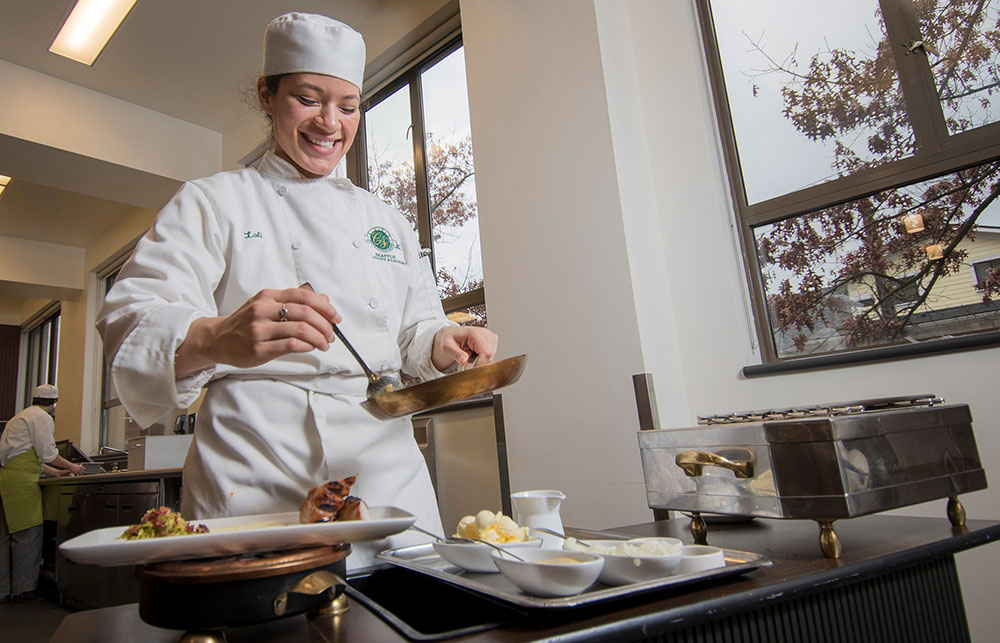
The Culinary Arts Program offers training for many positions in the growing field of food service and specializes in international cuisine. Students acquire practical skills and learn culinary theory in a variety of classes, through instruction that encompasses both food preparation and customer service.
Directed by chef instructors, students study and prepare foods utilizing contemporary methods and state-of-the-art equipment. During different quarters, students prepare and serve lunch daily in two dining rooms and the cafeteria. During fifth quarter, students create and serve a menu for their "Chef-of-the-Day" and participate in a management internship. Students may also choose to participate in banquets, recipe contests, scholarship competitions, cooperative education, and internships to further develop their skills and enhance their creativity.
Seattle Central's Culinary Arts program meets the needs of persons new to commercial food preparation; persons who have industry experience and wish to develop a broader range of skills; and persons who have a degree in another field and wish to make a career change.
Students study culinary arts for six quarters and earn a certificate of completion. After completing additional courses (approved by the counselor), students may earn an associate of applied science degree.
Career Opportunities
Culinary Arts is one of the fastest growing employment areas in the nation; positions are available throughout the United States. The demand for trained, qualified people is extremely high.
Both the certificate program and the associate of applied science program in Culinary Arts are accredited by the American Culinary Federation Education Institute.
Entrance Requirements
Because math and English are included in the Culinary Arts curriculum, students must take placement tests in these areas. The counselor may waive testing for students with a transcript showing equivalent college courses. Contact the Testing Office at 206 587-6913 for information or appointments (room BE 1108).
How to Get Started
- Complete the Standard Procedure for Admission to the College
- Tour of Facilities/Additional Information Schedule an appointment to meet the instructors, tour the facilities, or discuss any further questions with the Culinary Arts Office at 206 587-5424.
- Counselor Schedule an appointment with the department counselor at 206 587-5424 to interpret your test scores and determine your eligibility to enter the program. Students must bring test scores and/or transcripts to appointments. At the appointment, the counselor will determine student's placement on the approved list.
Counselor: Frances Kato, frkato@sccd.ctc.edu
- Contact the Culinary Arts Department to get your name on the mandatory placement list
- Registration Students who are admitted to the college and approved for program admission by the counselor may register for the program. These students will receive a registration appointment in the mail, and should collect a signed registration form from the Culinary Arts Office before registering.
Estimated Training Costs
- Tuition
- Photo ID Card (one-time fee)
- Student Activity Fee (per quarter)
- Transportation Mgmt Fee (per quarter)
- Computer Lab Fee (per quarter)
- Universal Technology Fee (per quarter)
- Lab Charge (per quarter) $100.00
- Wine Lab Charge $45.00
- Uniforms (approximate one-time fee) $275.00
- Hand Tools (approximate one-time fee) $300.00
- Textbooks (approximate) $500.00
- Food Handler's Permit (one-time fee) $10.00
- Name tag (one-time fee) $5.00
- Miscellaneous (approximate) $150.00
Curriculum
| 1'st Quarter | Cr | |
| CUL 101 | INTRODUCTION TO PROFESSIONAL COOKING: THEORY | 6 |
| Introduction to fundamentals of professional cooking. Includes historIntro to fundamentals of professional cooking, including food service y of food service industry, professional attributes, kitchen safety, shistory, professionalism, kitchen safety, equipment, ratios/weights/meanitation, nutrition, equipment and ingredient identification, basic kasures, pre-preparation, dry vs. moist heat cooking, stock/sauce theoritchen ratios, weights and measures, pre-preparation, knife skills, bay, ingredient identification, knife skills, and basic aromatic and flasic aromatic and flavoring combinations, and theory of moist and dry hvoring combinations. | ||
| CUL 111 | INTRODUCTION TO PROFESSIONAL COOKING: PRACTIUM | 6 |
| Hands-on introduction to professional cooking. Includes kitchen safetHands-on intro, includes kitchen safety, knife skills, basic cooking py, knife skills, basic cooking preparations, sanitation/clean-up, stocreparations, sanitation/clean-up, stock preparation, meat/poultry/seafk preparation, meat/poultry/seafood fabrication, inventory, knife sharood fabrication, inventory, knife sharpening, and mock sauce preparatipening, omelette cooking and mock sauce preparation. | ||
| HOS 101 | INTRODUCTION TO CUSTOMER SERVICE: PRACTICUM | 0.5 |
| Application of basic customer service theory in a full service restaurant or pastry case. Includes bussing, housekeeping, mise en place for both casual and formal restaurant settings, and customer service and sales techniques in bakery counter settings. | ||
| HOS 110 | PRINCIPLES OF SANITATION | 3 |
| Fundamentals of food service sanitation. Includes microorganisms in food spoilage and food-borne illness, ways of limiting microbial contamination and growth during each stage of food preparation and service, creating a clean and sanitary environment, accident prevention and first aid, sanitation in crisis situations, and principles of designing safe and sanitary kitchens. | ||
| MATH 110 | APPLIED MATH FOR TECHNICIANS | 3 |
| Emphasis on applications of mathematics to vocational and technical courses. | ||
| 2'nd Quarter | Cr | |
| BAK 114 | INTRODUCTION TO BAKING: PRACTICUM | 0.5 |
| For culinary arts students. Intro to production of baked goods. Includes ingredient identification and preparation of quick breads, pies, tarts, cookies, biscuits, muffins, coffee cakes, cornbread, and popovers. | ||
| CUL 102 | QUANTITY COOKING: THEORY | 5 |
| Continued introduction to professional cooking, particularly theory reContinuation of professional cooking, particularly theory relating to lating to quantity food production. Includes trade terminology, heavyquantity food production. Includes trade terminology, heavy equipment, equipment, tool identification, mise en place, soups, salads, meats, tool identification, mise en place, soups, salads, meats, fish, vegetables, starches, hors d'oeuvres, garnishes, and presentation. | ||
| CUL 112 | QUANTITY COOKING: PRACTIUM | 8 |
| Students will prepare a variety of meals suitable for volume feeding Preparation of international cafeteria-style meals. Includes mise en pin a cafe-type setting. Recipes and cooking methods discussed lace, item marketing, equipment operation, and preparation of meals frin the classroom will be implemented under supervision of the chef om the Italian, Asian, Middle Eastern, Mexican, Creole, Indian, Frenchinstructor. and American traditions. | ||
| CUL 150 | ||
| Intro to the current ecological, economical and political issues relating to the food system. Raises awareness of issues of the food system from producer to consumer, exploring agriculture, fisheries, dairy, meat and poultry production, water and waste. Includes trade, health and social justice issues within the food system. | ||
| HOS 102 | CUSTOMER SERVICE: PRACTICUM | 1 |
| Students refine customer service skills by further practice in a pastrRefine customer service skills by further practice in a pastry case ory case or full-service restaurant. Includes dining room arrangement, full-service restaurant. Includes dining room arrangement, buffet setbuffet setup and wait staff duties. In the bakery counter setting, stup and wait staff duties. In the bakery counter setting, students pracudents practice product rotation and merchandising. | ||
| HOS 122 | PURCHASING AND INVENTORY: THEORY | 1 |
| Intro to principles of food costing and inventory procedures. Encompasses formal and informal purchasing methods, flow of goods, food buying, legal and ethical purchasing considerations, market analysis, stock rotation, bid specifications, yield and cost comparisons, quality tests and inventory. | ||
| HOS 123 | FOOD COSTING PRINCIPLES AND APPLICATION | 1 |
| Explores connection between profit and food cost; discusses product waste and defines costing terms and purchasing units. Use mathematics skills to make conversions, cost bulk and subrecipes, and calculate the selling price of a menu item. | ||
| 3'rd Quarter | Cr | |
| BAK 105 | RESTAURANT BAKING: THEORY | 1.5 |
| For culinary arts students. Expands on science and principles of baking, including yeast doughs and formulas, icing techniques, basic cake types, and characteristics of desserts. | ||
| BAK 115 | RESTAURANT BAKING: PRACTICUM | 0.5 |
| For culinary arts students. Production of baked goods including ganache, custards, creams, puddings, mousses and purees. | ||
| BIOL 103 | NUTRITION FOR FOOD SERVICE PROFESSIONALS | 3 |
| Identification of the known nutrients for human health; demonstration of dietary quality guidelines; utilization of dietary guidelines in meal planning, including modification of existing recipes to meet nutritional recommendations. | ||
| CUL 103 | RESTAURANT COOKING: THEORY | 5 |
| Restaurant-level professional cooking, particularly menu planning, ordRestaurant-level professional cooking, particularly menu planning, ordering, and preparing/producing complete meals. Also includes culinaryering, and preparing/producing complete meals ala minute. Also include French, restaurant kitchen organization, fresh herb identification, es restaurant kitchen organization, fresh herb identification, seasonalxotic vegetable/starch identificaion, market fluctuations/trends, yiel vegetable/starch identification, market fluctuations/trends, plate prd grades, plate presentation, cost control, purchasing, condiment prodesentation, cost control, purchasing, condiment production, menu writiuction, menu writing, advanced cooking techniques, advanced fabricationg, advanced cooking techniques, advanced fabrication, and recipe convn, and recipe conversions, requisitions, and modifications. | ||
| CUL 113 | RESTAURANT COOKING: PRACTIUM | 8 |
| Preparation of meals for on-campus restaurant, emphasizing creativity.Preparation of meals for on-campus restaurant, emphasizing creativity. Includes kitchen rotations, speed/organization emphasis, plate prese Includes kitchen rotations, speed/organization emphasis, plate presenntation, quality assessments, menu planning. French menus and terminotation, quality assessments, menu planning, seasonal products and termlogy, innovative products, flexibility, teamwork, supervision, inventoinology, innovative techniques, flexibility, teamwork, supervision skiry, receiving, distribution, product evaluation, fabrication and prepalls, inventory, receiving, distribution, product evaluation, fabricatiration of complex soups, sauces, aiolis, dressings, sides and entrees on and preparation of complex soups, sauces, aiolis, dressings, sides from international and blended traditions. | ||
| HOS 103 | CUSTOMER SERVICE & FOOD COST ANALYSIS II: PRACTI | 1 |
| Students acquire expertise in customer service by performing opening/cAcquire expertise in customer service by performing opening/closing prlosing procedures, displaying French, English and Russian table servicocedures, using a variety of service techniques, and training bus stafe, and training bus staff. | ||
| 4'th Quarter | Cr | |
| BAK 116 | FINE DINING BAKING: PRACTICUM | 0.5 |
| For culinary arts students. Applies baking theory to production of yeast doughs (bread, puff pastry and choux), breads, focaccia, cakes, icings, decorations, mousses, tortes, puff pastries, and fine plated desserts. | ||
| CUL 104 | INTERNATIONAL COOKING: THEORY | 4 |
| Building on previous theory courses, this course emphasizes internatioEmphasizes international fine dining cooking theory. Includes Latino, nal fine dining cooking theory. Includes Italian, Japanese, MediterraJapanese, Mediterranean and other international terminology; extensivenean and other international terminology; extensive nutritional discus nutritional discussion; menu feasibility studies; international ingresion; menu feasibility studies; international ingredient identificatiodient identification; fine dining kitchen organization; international n; fine dining kitchen organization; international cooking methods; cocooking methods; cooking method adaptations; written requisitions; garoking method adaptations; written requisitions; garnitures; advanced pnitures; advanced plate presentation; advanced cooking methods; menu wlate presentation; advanced cooking methods; menu writing; and recipe riting; and recipe studies. | ||
| CUL 114 | INTERNATIONAL COOKING: PRACTICUM | 8 |
| Provides hands-on training in cooking and preparing meals for fine Preparation of meals for on-campus fine dining room. Heavy emphasis ondining. Student will exhibit skills in the preparation and plate presentation, accuracy, speed, organization, professionalism, wpresentation of these dishes in a full-service restaurant. ork habits, ethnic ingredients, healthy cooking methods, restaurant vsLeadership skills will be exercised. . fine dining kitchen organization, advanced fabrications, garniture and timing. Also covers pasta-making, sushi, tempura, pan-searing, pan-smoking, shallow-poaching and production of fine classical/contemporary Latino, Mediterranean, Japanese and student-created international menus. | ||
| HDC 106 | INTERVIEWING,RESUMES,JOBHUNTING,EMPLOYER/EE INTE | 2 |
| Short, intensive course in creative job-hunting techniques: how to identify personal skills and focus a job search; where and how to look for jobs; how to get hired. | ||
| HOS 104 | TABLE SERVICE: PRACTICUM | 1 |
| Introduction to leadership positions in the dining room. Mastery of FIntro to leadership positions in the dining room. Mastery of French serench service; exhibition of tableside food preparation and service inrvice; exhibition of tableside food preparation and service in a fine a fine dining setting. Encompasses maitre dhotel duties, supervisiodining setting. Encompasses maitre d'hotel duties, supervision of openn of opening/closing, training of wait staff and kitchen liaison dutieing/closing, training of wait staff and kitchen liaison duties. Prereqs. | ||
| HOS 124 | COMPUTERIZED MENU PLANNING | 1 |
| Learn computers and word processing programs used to write recipes and menus. Includes basic MS Word skills, layout, design, formatting, grammar and descriptive writing. | ||
| 5'th Quarter | Cr | |
| CUL 120 | INTRODUCTION TO WINE | 2 |
| Covers the fundamentals of grape growing and winemaking, including table, sparkling and fortified wines. Includes sensory evaluation of classic grape varieties and their growing regions with emphasis on Washington state wines. Learn strategies for food and wine pairing. | ||
| CUL 200 | ADVANCED CULINARY MANAGEMENT | 1 |
| Short, off-campus internship at local restaurant, caterer, hotel or other food service operation, emphasizing the management perspective. Includes on-site diary. | ||
| CUL 203 | CHEF OF THE DAY: PRACTICUM | 4 |
| Design and full implementation of a self-created menu in one of the on-campus restaurants. Under supervision, students design their own menus and prepare for its production, including inventory, requisitions, receiving, costing, recipe development, plate presentation, job descriptions and assignments. Menu production supervised by the student and faculty members. Includes a final portfolio, judged on creativity, outcome and organization. | ||
| ENGL 105 | APPLIED COMPOSTION | 3 |
| Covers skills and strategies needed to meet writing demands in college and on the job. | ||
| HOS 108 | DINING ROOM AND KITCHEN MANAGEMENT | 2 |
| Covers management and supervision practices within the hospitality and culinary arts industries. | ||
| HOS 201 | FUNCTIONS OF MANAGEMENT | 2 |
| Covers management and communication theories and practices within the culinary arts and baking industries. Includes current issues: introduction to hospitality, Americans with Disabilities Act, sexual harassment, and other legal and human resource issues. Covers communications skills, functions of management, beverage management, and financial statement analysis. | ||
| Summer Qtr (Prereq: Successful completion of 1 qtr in the culinary program) | Cr | |
| CUL 251 | BUFFET CATERING/GARDE MANGER/ICE CARVING:THEORY | 4 |
| Floating summer quarter class. Intro to buffet, garde manger and ice carving principles. Includes theory discussion of buffet arrangement, garde manger, smoking and ice carving techniques, non-edible displays, aspic/gelee/chaud froids, garnishes, caviar, forcemeats and pates, cold sauces, charcuterie, foie gras, yeast breads, truffles, terrines, galantines, mousses, cures vs. brines, marinades and recipe studies. | ||
| CUL 255 | BUFFET CATER/GARDE MANGER/ICE CARVING:PRACTICUM | 8 |
| Floating summer quarter class. Intro to the preparation of ice carvings, buffet items and garde manger. Includes simple & complex salads; dressings; platter presentations, including forcemeat, galantines, mousses & pates; vegetable/fruit garnishes; yeast & quick breads; hot & cold international entrees; pastries, petits fours, cakes & desserts; ice carvings; and food/table | ||
| HOS 109 | ADVANCED CUSTOMER SERVICE | 0.5 |
| Further exploration of customer service including communication strategies, behavior assessments, complaint resolution, customer characteristics, professionalism, teamwork, buffet arrangements and display of ice carvings. Pass/fail grade. | ||
| PSYC 240 | PSYCHOLOGY OF HUMAN RELATIONS | 3 |
| (Formerly PSY 220.) Covers dynamics of organizations and human resources in the workplace: motivational theory, leadership, group processes, organizational theory, participatory management, conflict management and counseling. Primarily for vocational students. | ||
| Total Credits = 100 | ||
Note: Class times vary between the hours of 7:00 a.m. and 3:00 p.m. Tuesday through Friday.
For Further Information:
Culinary Arts Program
Seattle Culinary Academy
Seattle Central Community College
1701 Broadway, Room BE2120
Seattle, WA 98122
PHONE: (206) 587-5424
FAX: (206) 344-4323